


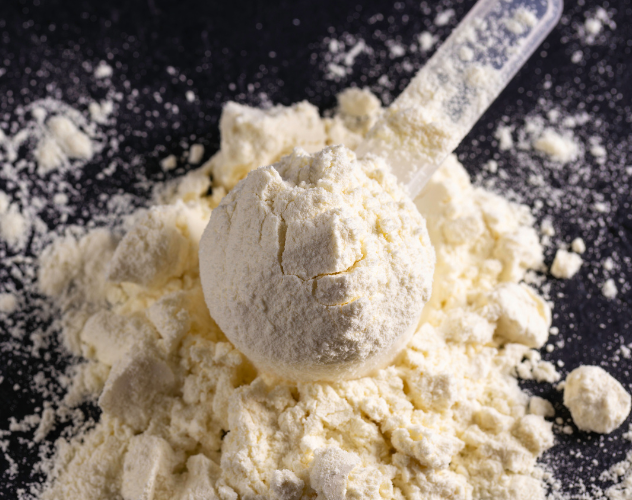
Caseinates: Unlocking the Functional & Economic Value of Milk Proteins
Grace Lewis, Ph.D.
Protein demand continues to rise, but not all proteins deliver the same benefits. According to Cargill’s Protein Profile, 61% of consumers reported increasing their protein intake in 2024, up from 48% in 2019 (Cargill, 2025). Whey protein remains a familiar choice for high-protein formulations, but casein and caseinates bring distinct nutritional and functional characteristics to the table. From their slower digestion profile to their versatility in food and nutrition applications, these milk proteins can offer formulators advantages that whey alone may not provide.
MILK PROTEINS
Milk contains two primary classes of proteins: casein and whey. In bovine milk, casein accounts for approximately 80% of the total protein content, while whey proteins contribute the remaining 20% (Dalgleish and Corredig, 2012). Both are considered high-quality protein sources because they provide all essential amino acids, exhibit excellent digestibility, and contain high concentrations of branched-chain amino acids (BCAAs; Davoodi et al., 2016). Despite these shared nutritional attributes, casein and whey proteins differ significantly in their physical structure, digestion kinetics, and functional properties.
In milk, casein proteins are organized into large, spherical structures known as casein micelles, which typically measure around 200 nm in diameter (Dalgleish and Corredig, 2012). These micelles are substantially larger than individual whey proteins, which exist as much smaller, soluble globular proteins. Under normal milk conditions, the surface of casein micelles carries a net negative charge, creating electrostatic repulsion that helps maintain system stability.
However, as environmental conditions change, the behavior of casein proteins changes as well. During gastric digestion, for example, the pH decreases and the negative surface charge of the micelles is progressively neutralized. As a result, casein micelles begin to aggregate and form a clot or gel network within the stomach (Dupont and Tomé, 2020). This clotting behavior slows gastric emptying and protein digestion, contributing to increased satiety and a more gradual, sustained release of amino acids. In contrast, whey proteins remain soluble under gastric conditions and are digested more rapidly, leading to a faster rise in circulating amino acid levels.
The acid-induced aggregation of casein is not only important nutritionally but also forms the basis of many dairy processing applications (e.g., yogurt). Furthermore, controlled acidification and casein precipitation are key steps in the manufacture of caseinates, a versatile class of dairy ingredients valued for their functional performance in food systems. As demand for high-protein foods continues to grow, caseinates provide manufacturers with a functional and often more cost-effective alternative to formulations relying on increasingly expensive dairy protein blends. The following sections explore caseinates in greater detail.
CASEINATE MANUFACTURING
Caseinates are produced through the acid precipitation of casein proteins, followed by neutralization with a dilute alkaline solution (Mulvihill and Fox, 1992). The neutralizing agent determines the final ingredient type. For example, the use of sodium hydroxide produces sodium caseinate, while potassium hydroxide yields potassium caseinate. Other alkaline salts may also be used to generate additional caseinate variants.
The neutralization step is particularly important because it influences the intermolecular interactions among casein molecules and the functional properties of the final ingredient. By carefully controlling processing conditions, manufacturers can tailor functionality such as solubility, emulsification performance, and water-binding capacity to meet the requirements of specific food applications.
Following neutralization, the caseinate solution is typically heated and then spray dried to produce a stable powdered ingredient. Importantly, the cation introduced during neutralization, whether sodium, potassium, or another mineral source, remains within the final powder. Both the type and concentration of this salt can significantly influence caseinate structure and functionality (Carr and Golding, 2016).
The resulting powder retains the nutritional benefits of native casein proteins, including their high-quality amino acid profile, while exhibiting functional properties that differ substantially from those of casein in its native micellar form. These differences are likely due to the physical structure of the casein protein aggregates. Using light scattering techniques, Lucey et al. (2000) reported caseinates adopt highly elongated and flexible conformations in solution with root-mean-square radius values ranging from approximately 50 to 120 nm.
CASEINATE FUNCTIONALITY
As highlighted above, it has been proposed that caseinates exist in flexible, nonspherical, and elongated conformations in solution (Lucey et al., 2000; Huppertz et al., 2017). This unique structure enables caseinates to retain the nutritional benefits of casein while exhibiting functional properties that are often superior to those of native casein micelles. As a result, caseinates are widely utilized across food and beverage applications where emulsification, texture development, thermal stability, and gelation are critical to product performance:
- Interfacial properties: Caseinates readily adsorb to both oil-water and air-water interfaces, making them highly effective emulsifiers and foaming agents in multiphase food systems. In emulsions, caseinates form thick, viscoelastic interfacial films around oil droplets, helping to prevent coalescence and improve stability. Their emulsifying properties have been used in the development of delivery systems for hydrophobic bioactive compounds, including nutraceuticals such as β-carotene (Yi et al., 2014) and curcumin (Qu et al., 2021). Similarly, at air-water interfaces, caseinates enhance foam formation and stability, contributing desirable whipping characteristics in products such as ice cream and whipped toppings (Abascal and Gracia-Fadrique, 2009; Carr and Golding, 2016).
- Viscosity and texturization: The high water-binding capacity of caseinates contributes to improved hydration, increased viscosity, enhanced moisture retention, and greater body in finished products (Carr and Golding, 2016). These properties make caseinates valuable texturizing ingredients in a variety of applications, where they can improve mouthfeel and reduce syneresis. Their ability to build viscosity while remaining relatively soluble also makes them attractive for liquid and semi-solid food systems.
- Heat stability: Caseinates also maintain functionality under a broad range of processing conditions, including thermal processing (Carr and Golding, 2016). This heat stability enables their incorporation into products exposed to thermal processes, including extrusion, ultra-high-temperature (UHT) processing, and retorting. Importantly, caseinate-stabilized emulsions have been found to retain their structural integrity during thermal treatments, helping maintain product quality and shelf stability (Srinivasan et al., 2003).
- Gelation: Under appropriate conditions, caseinates can also contribute to gel formation. When combined with selected hydrocolloids, such as locust bean gum, caseinates can participate in the development of gel networks with varying firmness and textural characteristics (Tang et al., 2021). This functionality allows for tailored texture and structure in a range of food applications, from dairy-based systems to hybrid formulations requiring specific rheological properties.
CONCLUSION: WHAT ARE THE BENEFITS FOR MANUFACTURERS
Together, these properties position caseinates as far more than a protein ingredient. Their combination of nutritional quality, processing resilience, formulation versatility, and cost-effectiveness makes them valuable for product developers seeking to improve performance across a broad spectrum of food and beverage applications. As dairy protein markets continue to experience periods of price volatility, caseinates represent a practical tool for balancing product performance with cost optimization.
REFERENCES AVAILABLE UPON REQUEST.